A GEO/AEO platform for auditing brand visibility in AI-generated answers
Geovio audits how a brand appears in answers from ChatGPT, Claude, Gemini and Perplexity. A user provides a website and business description, then receives a set of audience queries, mention and ranking analysis, competitor insights, recommendations and an exportable report.
Working product
Public access is currently offline. The product can be redeployed for further use and development.
Developed from April to May 2026
Role: Product concept, user workflow research, UX/UI, independent frontend and backend development, data architecture, LLM integrations, authentication, payments and production deployment
Stack
- Nuxt 3
- Vue 3
- TypeScript
- Tailwind CSS
- Python
- FastAPI
- OpenRouter
- Supabase
- PostgreSQL
- Supabase Auth
- Row Level Security
- SSE
- WeasyPrint
- Jinja2
- Docker
- Nginx
- YooKassa
- Timeweb Cloud
- reports generated by real users
- 72reports generated by real users
- AI systems covered by one audit
- 4AI systems covered by one audit
- queries in a standard audit
- 15queries in a standard audit
- from product concept to production launch
- 2 monthsfrom product concept to production launch
Context and challenge
People increasingly get a finished answer from an AI system rather than a list of search results. That alone is enough to make classic search rankings stop answering the question that matters for a brand: does it appear in AI-generated answers at all, and in what shape?
Checking this by hand is possible but expensive in time: you have to write the typical queries your audience would ask, work through several systems one by one, record every answer, and note whether the brand is mentioned, in which position, in what context, and who gets named instead.
Results collected that way are hard to compare with each other, hard to repeat on a regular basis, and hard to turn into a concrete plan of improvements.
What was needed was a single product workflow: from a website URL to a legible dashboard, a set of recommendations and a finished report that can be saved and shared with a team.
Who the product is for
- marketers and heads of marketing
- owners and leads of digital products
- SEO, GEO and content specialists
- agencies tracking the visibility of their clients
- companies that need to compare their brand against competitors
- specialists who need a report without querying each AI system by hand
From a website to a complete GEO/AEO report
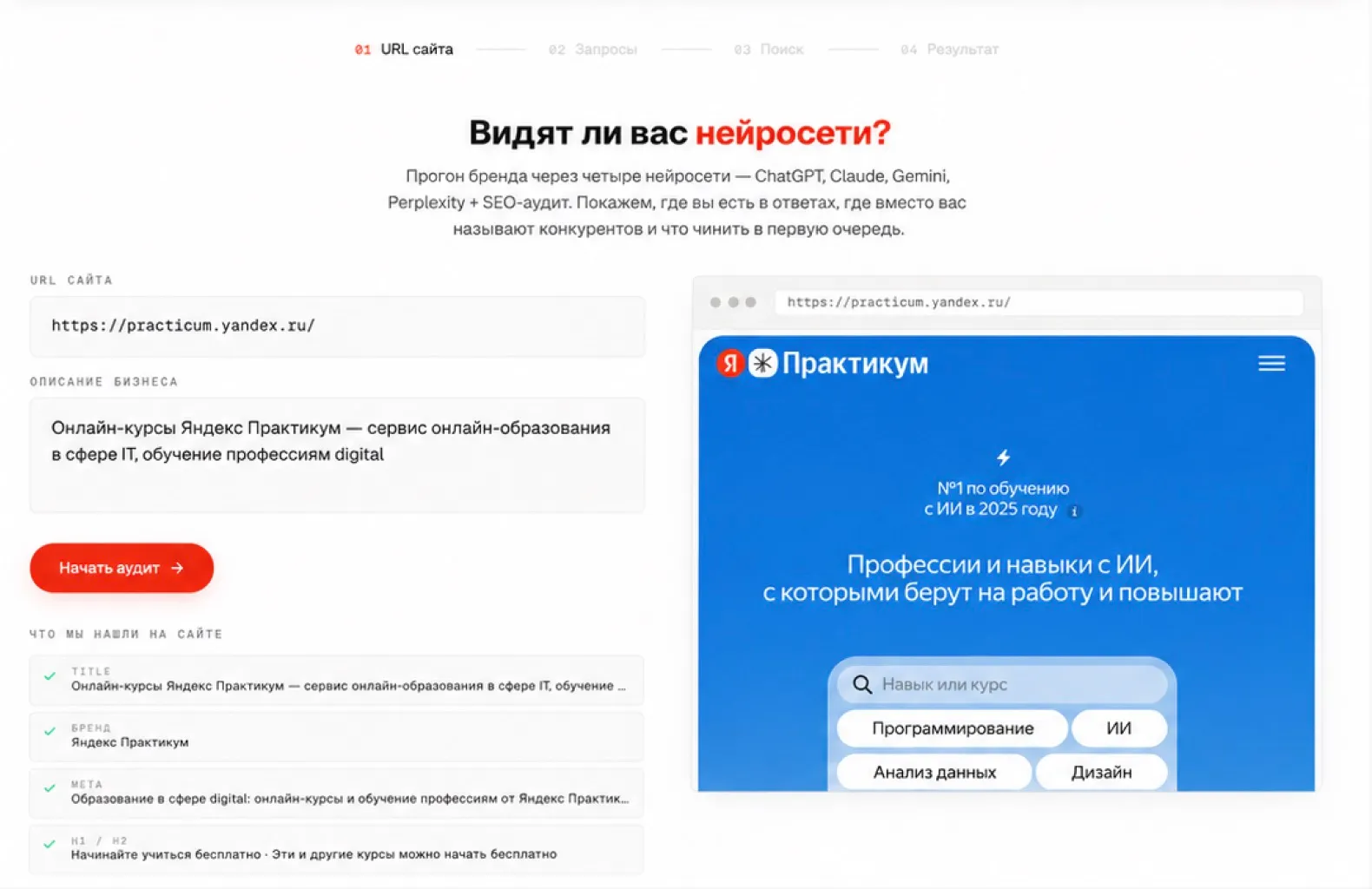
A user enters a URL and a business description. The service analyses the site and suggests brand name variants, while an AI model produces 15 typical audience questions. Both the queries and the brand variants can be edited before the run starts.
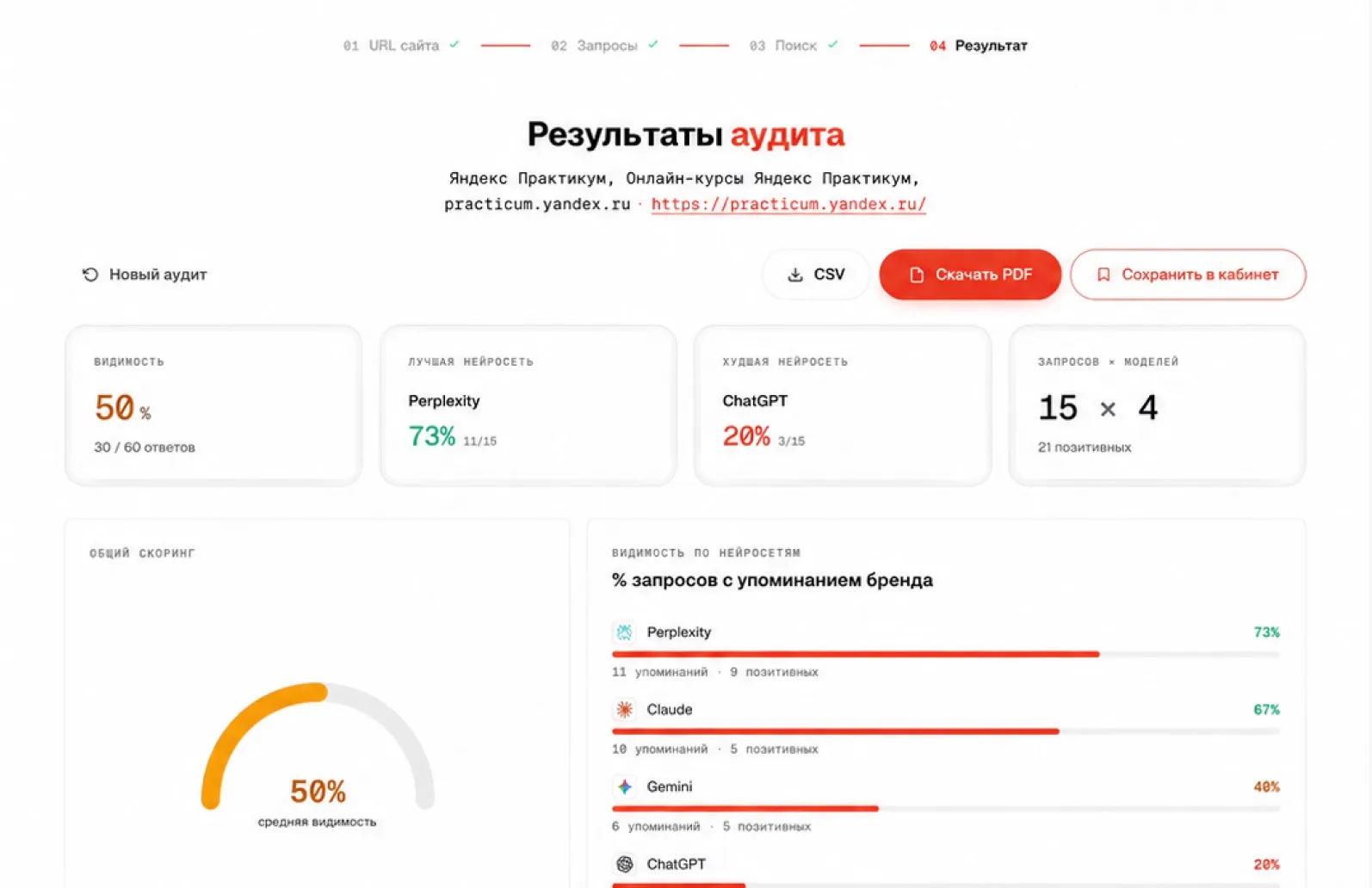
The system then queries ChatGPT, Claude, Gemini and Perplexity and analyses each answer: whether the brand is mentioned, in which position, in what context, with what sentiment, and which competitors are named alongside it.
The result is a dashboard, a set of recommendations, an SEO/GEO checklist and an exportable report that is kept in the user’s dashboard.
Site parsing and brand detection
The service reads the page title, metadata and headings and suggests variants of the brand name.
Query generation and editing
15 typical audience questions, each of which can be changed, removed or replaced with the user’s own.
An audit across four AI systems
ChatGPT, Claude, Gemini and Perplexity are covered in one run, with no need to query each of them by hand.
Mention analysis
Whether the brand appears in the answer, its position, the surrounding context, the sentiment, and the competitors found next to it.
Real-time progress
The user watches each query-by-system pair being processed rather than waiting for a single final result.
Dashboard and recommendations
An overall score, per-model results, positions, competitors, priority actions and an SEO/GEO checklist.
Account and audit history
Sign-up, saved reports, access to previous audits and the option to run a check again.
Exporting the results
PDF and CSV reports for further work and for sharing with a team or a client.
My role
I took Geovio through the full product cycle on my own: I researched the problem and the user workflow, defined the product model, designed the UX/UI and the architecture, built the frontend and the backend, connected the AI systems, the database, authentication and the payment infrastructure, deployed the product to production and validated it against real user activity. AI-assisted development helped me move faster through design, writing code and checking scenarios, while the requirements, product decisions, architecture and final verification stayed my responsibility.
- researched how visible brands are in AI-generated answers
- defined the product model of a GEO/AEO audit
- designed the full user journey from a URL to a finished report
- structured the audit as four steps
- designed the UX/UI of the public site, the audit, the results and the dashboard
- independently built the frontend in Nuxt and Vue
- independently built the backend in Python and FastAPI
- developed site parsing and detection of brand name variants
- implemented generation and editing of user queries
- connected four AI systems through OpenRouter
- implemented progress streaming over SSE
- implemented analysis of mentions, positions, sentiment and competitors
- developed the recommendation engine with fallback scenarios
- implemented the SEO/GEO checklist
- developed PDF and CSV export
- designed the storage model for users, audits and results
- connected Supabase Auth, PostgreSQL and access separation
- built the user dashboard and the audit history
- implemented the payment flow through YooKassa
- prepared the Docker configuration, Nginx and the production deployment
- configured the domain and the public infrastructure
- tested the user and technical scenarios
- reviewed feedback and refined the product
- took sole responsibility for the finished product and for keeping it working
I designed Geovio not as a one-off check of a few answers, but as a complete product workflow: from a website and the questions its audience asks through to a comparable dashboard, recommendations and a report that can be saved and put to work.
From an idea to a working GEO/AEO service
- April 2026
Problem research and product model
Established what data is needed to check a brand’s AI visibility, how to build the queries an audience would ask, and how to turn answers from different systems into a comparable result.
- Design
User journey and architecture
Designed the sequence from site analysis and query editing through to the audit, the recommendations, saving and exporting the results.
- May 2026
Independent implementation
Built the frontend, the backend, data processing, the AI system integrations, authentication, the user dashboard, the payment flows and the reporting.
- Production
Launch and real user activity
Deployed the service on a public domain. Real users worked with the product and generated 72 reports.
Technology and approach
The product brought together several separate layers: a public site, a step-by-step audit interface, a server-side processing pipeline, four AI systems, a database with authentication, a user dashboard, document export, payment infrastructure and a production deployment. The architecture kept them apart so new AI systems and deeper analytics could be added without rebuilding the whole service.
Interface and user workflow
Nuxt 3, Vue 3, TypeScript and Tailwind CSS power the step-by-step audit, the processing progress, the dashboard and the user area.
Backend and AI pipeline
Python, FastAPI, OpenRouter and SSE handle query generation, querying the models, analysing the answers and preparing recommendations.
Data and access
Supabase, PostgreSQL, Auth and row level security store users, profiles, balance, audit history and results.
Reports and production
WeasyPrint, Jinja2, Docker, Nginx, Timeweb Cloud and YooKassa handle PDF and CSV reports, deployment, API routing and the payment flows.
Outcome
In two months Geovio went from a product idea to a working production service. Users could sign up, audit their brand’s visibility across four AI systems, keep the result in their dashboard and download a finished PDF or CSV report.
- real users generated 72 reports
- a single audit covered ChatGPT, Claude, Gemini and Perplexity together
- a standard run included 15 user queries
- site parsing and detection of brand name variants worked
- users could edit both the queries and the brand name
- the system identified mentions, positions, sentiment and competitors
- the results were brought together in one dashboard
- the recommendations and the SEO/GEO checklist worked
- PDF and CSV reports were implemented
- sign-up, authentication and the user dashboard worked
- previous audits were saved and could be reopened
- payment infrastructure through YooKassa was implemented
- the product was deployed on a public domain
- the project was independently designed and built by Daniil
Gallery
Current status
Geovio was deployed to production and used by real users, who generated 72 reports. The public deployment is currently offline.
The product can be redeployed and taken further: the architecture supports adding new AI systems, extending the analytics, developing the recommendations and building scenarios for regular monitoring.