A multi-agent AI operations system for foreign trade workflows
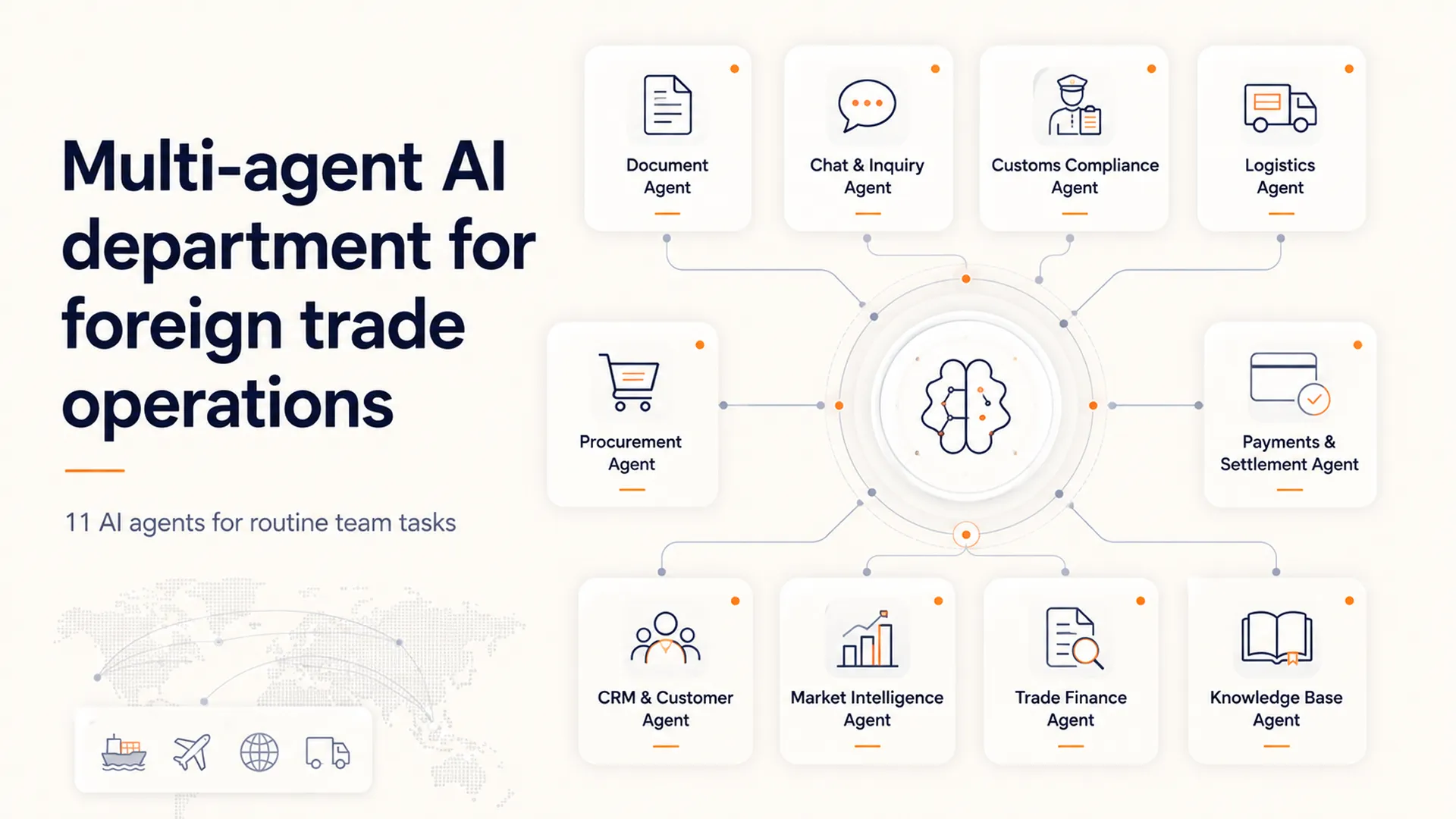
An internal system of 11 AI agents built for the GORAZH Group team. An employee submits a task in Telegram, and the orchestrator routes it to a specialist or turns it into a multi-stage project with human approval at each step. The system uses context from Aspro.Cloud and an internal knowledge base, works with documents, and supports analytical, legal, logistics and commercial workflows.
Internal system
Access is limited to the GORAZH Group team.
Development began in May 2026; the system is in use and continues to evolve
Role: Product concept, workflow research, system architecture, agent design, independent implementation, Telegram, CRM and knowledge-base integrations, deployment and ongoing development
Stack
- Python
- Telegram Bot API
- OpenRouter
- Claude
- Perplexity Deep Research
- SQLite
- Aspro.Cloud API
- Knowledge Base
- Semantic Search
- Document Processing
- XLSX
- Mac Mini
- specialised AI agents
- 11specialised AI agents
- operating modes
- 3operating modes
- context sources: CRM and knowledge base
- 2context sources: CRM and knowledge base
- working entry point — Telegram
- 1working entry point — Telegram
Context and challenge
GORAZH Group is a single business partner for working with China end to end: from finding and vetting a supplier through manufacturing, quality control, logistics and customs clearance to international settlements. The company has offices in Moscow and Shanghai, more than 200 completed projects, and works with both industrial and consumer goods.
Within a single deal the team works on supplier sourcing and vetting, market analysis, contracts, finance, logistics, customs clearance and client-facing material all at once. The information behind that work is spread across colleagues with different expertise, the CRM, deal documents, working correspondence, internal guidelines and the results of previous projects.
To answer one working question an employee may need to assemble context from several sources, approach different specialists, and pass information between them by hand.
The goal was a single internal space where an employee states a task in plain language, gets help from the right specialist, works with the actual context of a specific deal, approves intermediate results and receives finished working material — while a person remains responsible for the final review of the outcome.
Who the product is for
- managers and leads running foreign trade projects
- supplier sourcing and vetting specialists
- lawyers
- finance specialists
- logistics specialists
- customs declaration specialists
- colleagues preparing commercial and client-facing material
- managers who need the context of a deal gathered in one place
One entry point for working with AI specialists
Employees work with the system inside a Telegram group. The orchestrator reads the message and picks one of three scenarios: a plain conversation with the system, a single task for a specialist agent, or a multi-stage project involving several specialists.
For a complex project the system proposes a plan, waits for the user to confirm it, opens a dedicated topic and passes the task from agent to agent. Each specialist in turn receives the results of the previous stages, and the user can approve the result, ask for revisions or stop the run.
The system ties four parts together: Telegram as the working interface, Aspro.Cloud as the source of the deal structure, the internal knowledge base as the source of what the documents actually say, and the AI agents as specialised working roles. A single deal code links the CRM record, the knowledge base folder and the working topic in Telegram.
Request orchestration
The system identifies the type of request and either routes it to a specialist agent or starts a multi-stage project.
Eleven AI specialists
The system runs a project manager, an observer, a market analyst, a lawyer, a finance specialist, a logistics specialist, a customs declaration specialist, an export specialist, a commercial proposal generator, a presentation specialist and a content specialist.
Multi-stage projects
For a complex task the system builds a plan, opens a dedicated Telegram topic and passes context from one specialist to the next.
Human approval
The user reviews intermediate results, confirms the next stage or sends the material back for revision.
Aspro.Cloud integration
The CRM is connected in read-only mode and supplies the structure of a deal: its stage, the client, the owner, dates and other working attributes.
Internal knowledge base
The system draws on deal documents, builds structured summaries and retrieves relevant context by meaning.
Documents and images
Agents can extract information from working files and photographs and use it in analysis and in preparing material.
Working files as output
The system helps produce XLSX tables with research results and PDF material for commercial work.
My role
I build and develop the entire product myself: I research the working processes, define the product model, design the agent roles and the user scenarios, implement the system and its integrations, deploy the working version and hand it over to the team. AI-assisted development serves as a tool to speed up design work, writing code and checking scenarios, while the requirements, the architectural decisions, the behaviour of the agents, testing and the final result stay with me.
- researched the company’s working processes and where AI could be applied
- defined the product model of an internal AI department
- set the roles and areas of responsibility of the 11 agents
- designed the orchestrator and the routing of requests
- developed the three operating modes of the system
- designed the multi-stage project scenario
- implemented planning and step-by-step approval of stages
- designed how agents interact inside Telegram topics
- set up separate Telegram bots for the specialist roles
- wrote and tuned the system instructions of the agents
- implemented the hand-off of context between project stages
- set up shared conversation memory
- implemented processing of documents and images
- connected deep research for investigative tasks
- implemented generation of XLSX and PDF files
- built the internal knowledge base of deal material
- implemented preparation of summaries from documents
- set up semantic search across the knowledge base
- integrated Aspro.Cloud in read-only mode
- linked the CRM, the knowledge base and the working topics by deal code
- set up validation and handling of technical errors
- deployed the system on always-on internal infrastructure
- tested the key user scenarios
- handed the working product over to the team
- continue to support and develop the system
I designed the system not as a set of independent chatbots, but as one working product: with task routing, specialist roles, the context of the deal, results handed from agent to agent, and mandatory human oversight.
From working processes to an internal AI-enabled product
- May 2026
Researching processes and roles
Established which working tasks could be handed to AI, where domain expertise is required, and how to keep human review of the results mandatory.
- Design
The orchestrator and the team of agents
Designed the specialist roles, request routing, the three operating modes, memory, multi-stage projects and the approval scenarios.
- Integrations
CRM, documents and knowledge base
Connected Telegram to Aspro.Cloud and to internal deal material, and implemented work with files, context retrieval and the generation of working documents.
- Now
In use and evolving
Handed the working system over to the GORAZH Group team and continue to extend the agents, the knowledge, the integrations and the user scenarios.
Technology and approach
The system had to behave as one internal product: accept tasks in Telegram, work out which specialist is needed, keep context, use the actual data of a deal and produce working material. The architecture separates the interface, the orchestration, the agents, memory, the integrations and the knowledge base, so the product can be extended gradually rather than rebuilt.
Telegram and orchestration
Telegram is the single working entry point. The orchestrator classifies the request, brings in an agent or starts an approved multi-stage project.
Models and specialised agents
Claude via OpenRouter powers the day-to-day work of the agents, while a separate research path handles tasks that need up-to-date deep search.
CRM and knowledge base
Aspro.Cloud supplies the structure of a deal in read-only mode, and the internal knowledge base supplies factual context from documents and prepared summaries.
Memory and working documents
The system keeps conversation context, handles common office formats and produces XLSX and PDF material for an employee to review.
Team and responsibilities
- Daniil Berdinskikh
- Product concept, workflow research, architecture, user scenarios, AI-assisted development, building and tuning the agents, integrations, testing, deployment and the further development of the product.
- GORAZH Group management and specialists
- Foreign trade domain expertise, populating the knowledge base, reviewing the working scenarios and the results produced by the system, using the product and providing feedback.
Outcome
The GORAZH Group team has a working internal system where a task can be raised through Telegram, routed to a specialist AI agent, or turned into a multi-stage project drawing on the CRM and the knowledge base.
- a working system of 11 specialised AI agents is in place
- Telegram became the single entry point for working with the system
- three scenarios are available: conversation, a single task and a multi-stage project
- complex tasks run to a plan with each stage approved in turn
- agents hand the context of previous work to one another
- Aspro.Cloud is connected as the source of the deal structure
- the internal knowledge base supplies the factual content of the documents
- the system works with documents and images
- generation of XLSX and PDF material is in place
- the results stay under the control of the employees
- the product was handed over to the team and is used in day-to-day work
- development and expansion of the system continue
Current status
The system is used by the GORAZH Group team in day-to-day work and runs on internal infrastructure. The specialist agents, request orchestration, multi-stage projects, the Aspro.Cloud integration and the internal knowledge base are all in operation.
I continue to develop the product: extending the agent scenarios, improving how the context of a deal is handled, growing the knowledge base and adding new integrations as feedback comes in from the team.