An AI platform for grant applications and reporting for non-profits
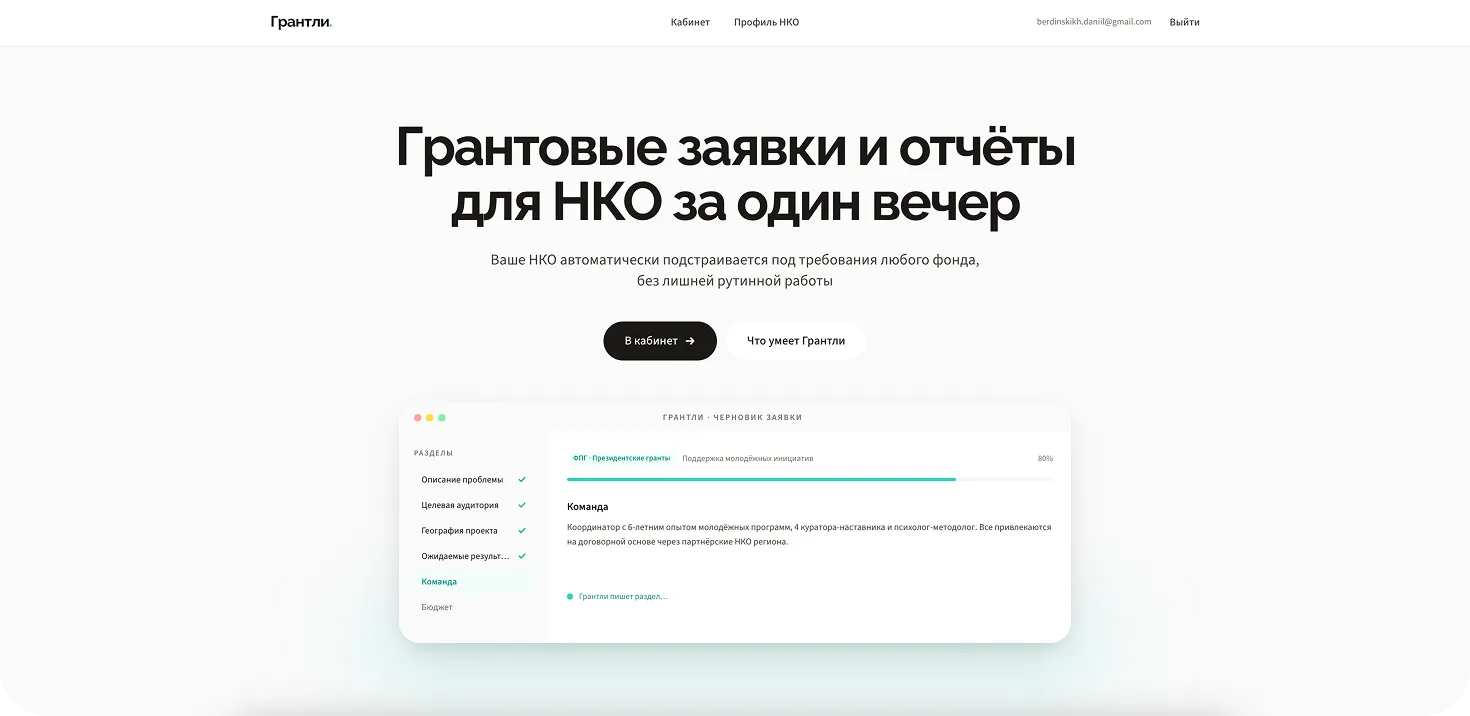
Grantli brings together an organisation profile, grant-maker requirements, section-by-section application preparation, plan-versus-actual reporting and a document library. Daniil Berdinskikh independently designed and built the working product, which was used by several non-profits.
Working product
Public access is limited. The product can be redeployed for its next stage of development.
Developed from April to May 2026
Role: Product concept, non-profit workflow research, UX/UI, architecture, frontend, backend, data, LLM workflows, document processing and production deployment
Stack
- Nuxt 3
- TypeScript
- Tailwind CSS
- Pinia
- Python 3.12
- FastAPI
- Supabase
- PostgreSQL
- Supabase Auth
- Row Level Security
- OpenRouter
- python-docx
- PyPDF2
- Docker
- Timeweb Cloud
- finalist in the nationwide Made with AI competition
- Top 10finalist in the nationwide Made with AI competition
- grant-maker templates
- 15grant-maker templates
- core workflows: applications and reports
- 2core workflows: applications and reports
- from initial development to a working product
- 2 monthsfrom initial development to a working product
Context and challenge
Non-profits regularly prepare applications for grant competitions and reports on completed projects. Each grant-maker has its own document structure, requirements and assessment criteria, while the same information about an organisation’s mission, team, audience, previous work and impact has to be reused across multiple documents.
For a small non-profit, preparing an application means bringing together the competition rules, the organisation profile, the project description, budget, targets and actual results. Information is often carried between documents manually, and the final material still has to be checked against the requirements of the specific grant-maker.
Grantli was designed as one working environment where an organisation profile becomes reusable context and applications and reports follow the structure of the selected grant-maker.
Who the product is for
- leaders of small and medium-sized non-profits
- project managers
- grant and fundraising specialists
- employees preparing applications and reports
- organisations without a dedicated grant team
- non-profits that need to retain and reuse information about their work
From an organisation profile to an application and report
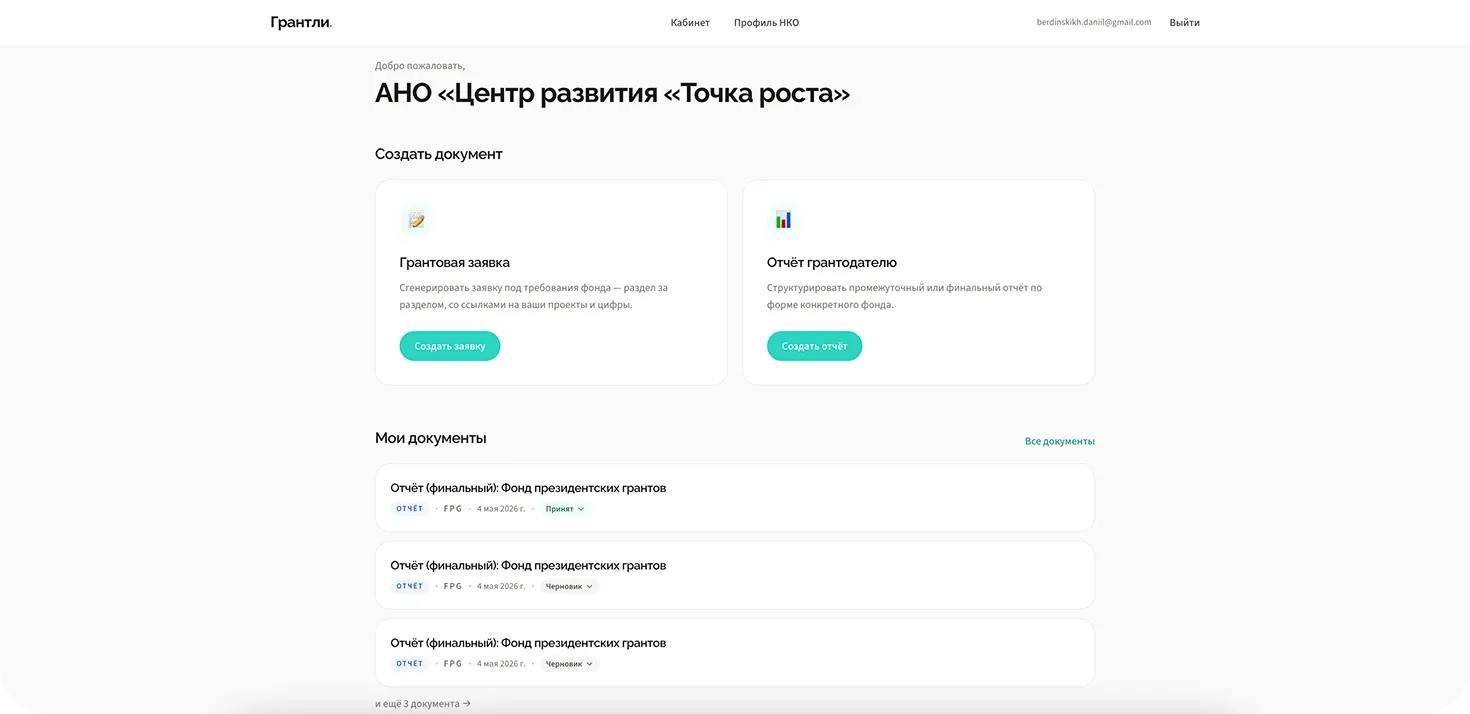
Grantli combines an organisation profile, a grant-maker catalogue, application and report workflows and a document library. A user enters the organisation details once, selects the required workflow and prepares the document step by step, keeping the result in the dashboard.
Organisation profile
The mission, audience, region, previous projects, outcomes and other organisation details are stored as reusable context.
Fifteen templates
The product includes structures and requirements for 15 grant-makers and programmes.
Section-by-section applications
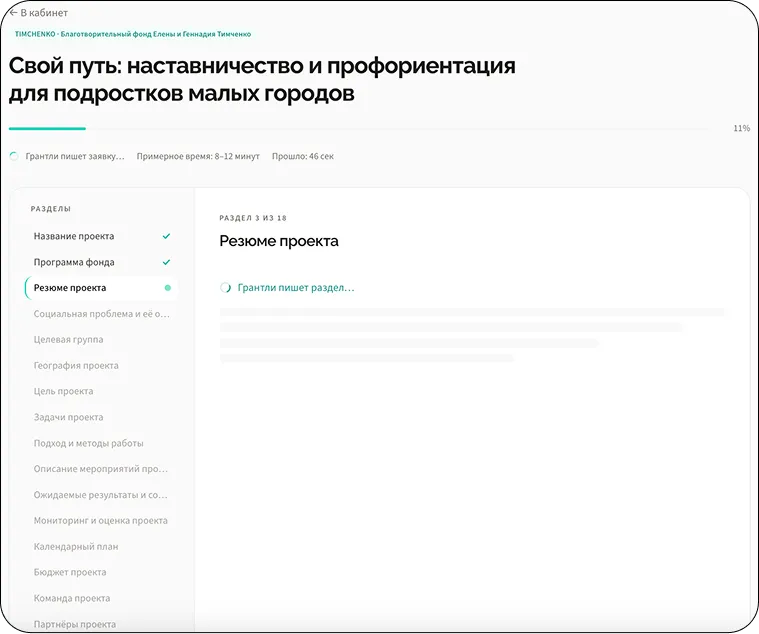
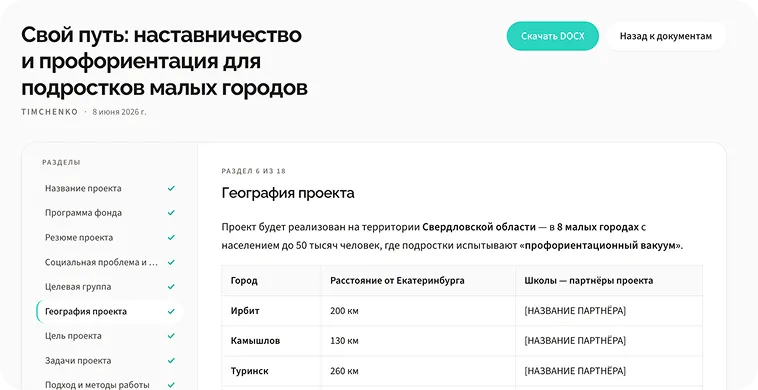
An application is prepared section by section using the grant-maker criteria and the context of the completed sections.
Revisions and regeneration
A user can revise individual sections and generate them again using additional instructions.
Plan-versus-actual reporting
The service compares the original application with the actual project results and prepares nine reporting sections.
Uploading a source document
A report can use an application stored in the system or an uploaded DOCX or PDF file.
Document library
Applications and reports are stored in one place and can be filtered by type and status for further work.
DOCX export
Prepared applications and reports can be downloaded as working documents for final review and submission.
My role
I independently took Grantli through the full product cycle: from defining the problem and the product model to UX/UI, architecture, frontend and backend development, data architecture, LLM workflows, file processing and production deployment. AI-assisted development helped accelerate design, coding and scenario checks, while the requirements, product decisions, architecture and final review remained my responsibility.
- researched how non-profits prepare grant applications and reporting
- defined the product model and the structure of the service
- designed the journeys for the public site, sign-up, onboarding and the dashboard
- developed the design system and the UX/UI of the product
- independently built the frontend in Nuxt and TypeScript
- independently built the backend in Python and FastAPI
- designed the data model for organisations, documents and templates
- set up Supabase Auth and access separation through row level security
- built the model of a single reusable organisation profile
- implemented the catalogue of 15 grant-maker templates
- developed section-by-section generation of grant applications
- implemented the hand-off of context between application sections
- added revisions and regeneration of individual sections
- developed the four-step reporting workflow
- implemented the comparison of the planned application against actual results
- added upload and text extraction from DOCX and PDF files
- built the document library with filters and statuses
- set up DOCX export of applications and reports
- prepared the Docker configuration and the production deployment
- tested the main user and technical scenarios
- took the product through to a working launch and use by real non-profits
I designed Grantli not as a one-off text generator, but as a working environment where a non-profit’s profile can be reused across applications, reports and future documents.
From an idea to a working product
- April 2026
Problem research and product model
Studied the structure of grant applications and reports, the core organisation data and the requirements of different grant-makers.
- Design
Profiles, documents and user workflows
Designed the product architecture, user journey, data model, dashboard and section-by-section document workflows.
- May 2026
Independent implementation
Built the frontend, backend, authentication, application and report workflows, file processing, export and production infrastructure.
- Competition final
A nationwide top-ten finalist
Grantli was selected as one of ten finalists in Yandex Practicum’s Made with AI competition. After launch, several non-profits registered and used the service to prepare applications and reports.
Technology and approach
The architecture had to isolate each organisation’s data, reuse the non-profit profile as shared context, support long section-by-section document workflows and process uploaded files. The product combines a Nuxt interface, a FastAPI backend, Supabase for data and authentication, and separate LLM workflows for applications and reports.
Interface and user workflows
Nuxt, TypeScript, Tailwind CSS and Pinia power the public site, onboarding, dashboard, generators and document library.
Backend and data
FastAPI handles organisation profiles, documents, templates, generation and export. Supabase stores the data and manages authentication.
Context and LLM workflows
The organisation profile, selected grant-maker requirements and previous sections provide context for preparing each document consistently.
Documents and production
The service extracts text from DOCX and PDF files, generates working DOCX documents and is deployed in containers on a cloud platform.
Outcome
Within two months, the idea became a working, free platform for non-profits, with an organisation profile, two core document workflows and a production deployment.
- Grantli reached the nationwide top ten as a finalist in the Made with AI competition
- the product was independently designed and built by Daniil
- templates for 15 grant-makers and programmes were prepared
- section-by-section preparation of grant applications works
- a separate plan-versus-actual reporting workflow works
- a user can create an organisation profile and reuse it
- applications and reports are kept in one document library
- upload of source DOCX and PDF files and DOCX export of finished documents are in place
- several non-profits registered on the service
- non-profits used the product to prepare applications and reports
- the working version of the product was deployed on a public domain
- the codebase and architecture allow the product to be redeployed and further developed
Gallery
Current status
Grantli is a working product that was independently built, deployed on a public domain and used by several non-profits to prepare grant applications and reports.
The architecture and codebase have been retained. The service can be redeployed, extended with additional grant-maker templates and continued as a free digital product for non-profits.